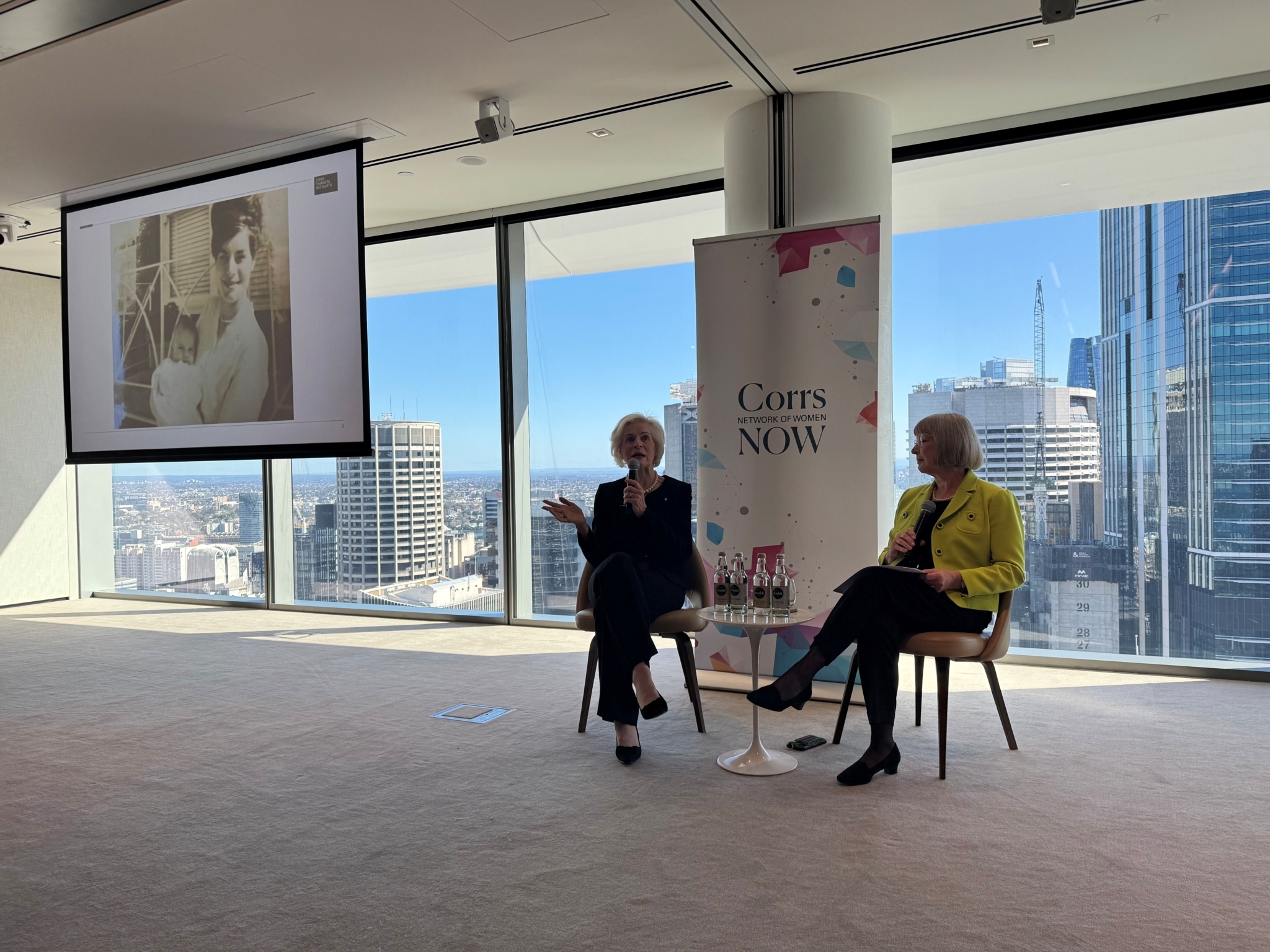
“Listening carefully is a great skill and applies in all areas of legal practice.” The Hon. Jennifer Boland AM.
Pictured: The Hon. Jennifer Boland AM in conversation with Corrs’ Head of Gender Equality Christine Covington at an event in our Sydney office.
A former litigation partner at Corrs, The Honourable Jennifer Boland AM practised in product liability and family law before retiring from the partnership in 1999. Her distinguished career continued with judicial appointments to the Family Court of Australia, the District Court of New South Wales, and the NSW Civil and Administrative Tribunal.
In 2012, The Honourable Jennifer Boland AM was appointed a Member of the Order of Australia in recognition of her service to the judiciary, legal education, and the community – particularly through her work with social welfare organisations.
Q1: What do you remember most fondly about your work at Corrs and the culture of the firm?
During my eleven years as a partner at Corrs, I had the opportunity to develop my practice as a litigator. It was a time of significant change for the firm, marked by the merger of Westgarth Baldick with Corrs Chambers Tully McNab. This transition presented me with an opportunity to work within a truly national firm rather than a Sydney-centric one, giving me exposure to and interaction with interstate colleagues. I also gained invaluable learnings from the firm’s leadership team, including James Strong and Rod McGeoch. The litigation division was a wonderfully collegiate group – partners, senior associates and solicitors alike – and while we worked hard, we also shared plenty of fun times. I fondly remember events like our “dress-up” dinner and ball at Paddington Town Hall and even cricket matches on an island in the harbour.
Q2: While at Corrs, you practised in both product liability and family law. What drew you to those areas, and how did they shape your approach to legal practice?
I commenced my legal career at a mid-sized firm, Michell Sillar and Brown, where I was the only female lawyer. In my first year I was thrown everything (worker’s compensation, debt recovery, personal injury litigation and family law). My fit with litigation was natural because I had worked for 12 years, the latter four when I completed the SAB (now LPAB) for the late John Traill, QC. My family law practice just took off, probably because I was older than the usual graduate and enthusiastic. After I had been with the firm for about 18 months, the late Colin Marks – a remarkable lawyer who acted for Johnson and Johnson – joined the firm and I first worked with him on amendments to J&J’s super scheme when de facto relationships were first legally recognised in NSW. This led to me becoming involved in litigation work for J&J and in particular product liability including international litigation concerning toxic shock syndrome. I was fortunate to be able to continue this work for J&J when I became a partner at Corrs. The diversity of my practice gave me widespread litigation experience including appearance work in both superior and inferior courts.
Q3: You were appointed as a Judge of the Family Court of Australia in October 1999, and later to the Appeal Division. How did your experience at Corrs prepare you for your transition to the judiciary?
The transition to the bench is probably initially more difficult for a solicitor than a barrister. You have to prove yourself not only to your judicial colleagues but to the bar. However, being part of a large corporate firm like Corrs gave me resilience and I was fortunate to have had the opportunity to engage in regular appearance work in courts. My transition to the appeal division was facilitated by wonderful colleagues who between them had many years appellate experience and I was able to learn and hopefully absorb much of their wisdom.
Q4: You’ve chaired and served on numerous legal and social welfare bodies over the course of your career. What drives your commitment to community service and legal education?
My legal career has provided me with many wonderful opportunities and benefits. I believe a judicial career comes both with privileges and responsibilities, so it follows that ‘giving back’ is a natural consequence. I have learnt much working with those in the not-for-profit sector and making a real difference in peoples’ lives. I have also been privileged to serve in a number of roles such as Chairperson of the Family Law Council, a role which provided an opportunity to provide advice to the Federal Attorney-General on legislative change, and as NSW representative on the Law Council of Australia’s Family Law Committee. As a late starter in the law, I have been delighted to regularly engage in continuing legal education presentations and particularly to encourage women to achieve to their fullest potential.
Q5: Being appointed a Member of the Order of Australia is a significant honour. What does that recognition mean to you personally and professionally?
My membership of the Order of Australia was an unexpected but a great honour. I hope that the honour recognises the value to our community of the legal profession and its highest ideals.
Q6: What is the best career advice you have ever been given? And what advice would you give to young lawyers starting out today, especially women entering the profession?
I have received different advice at many stages of my career and it’s hard to highlight a particular instance. Some advice as a ‘young judge’ stands out. First, I was told to “hear and decide” meaning getting judgments out in a timely manner. It’s good advice to any lawyer – don’t put off the hard matter or difficult client, it doesn’t get any easier if you procrastinate! Secondly, I was told by a very experienced judge to “shut up and listen”. Listening carefully is a great skill and applies in all areas of legal practice. And finally, try and have some life balance, it will stand you in good stead for the long haul.
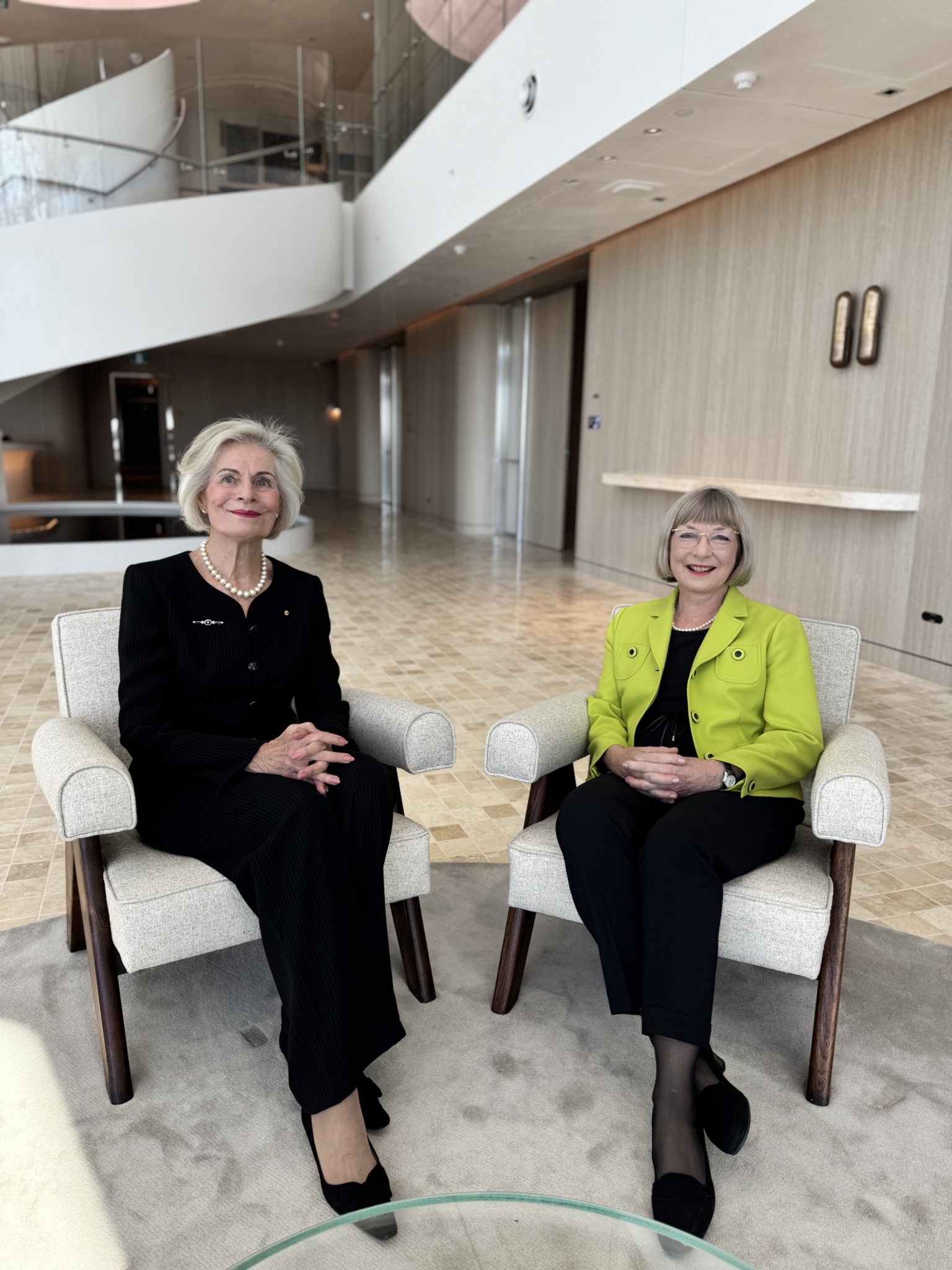
The Hon. Jennifer Boland AM (L) with our Head of Gender Equality, Christine Covington (R)