
Could the ESEM's warehouse model reshape renewable generation and storage investment across Australia?
20 October 2026
In September 2026, the Federal Department of Climate Change, Energy, the Environment and Water released for consultation draft legislation proposing to establish the Electricity Services Entry Mechanism (ESEM) as a permanent feature of the National Electricity Law (NEL). The ESEM aims to sustain investment in firmed renewable generation and storage across the National Electricity Market (NEM) once the Capacity Investment Scheme (CIS) concludes in 2027.
Against this backdrop, this Insight explores what the ESEM is and how it is proposed to operate, including the eligibility requirements and preferred contract structures for each service. It also considers the key bankability issues for sponsors and lenders, the opportunities presented by the ESEM’s warehouse model and the expected timeline for implementation.
What is the ESEM?
Born from the National Electricity Market Wholesale Market Settings Review, the ESEM would be a permanent mechanism established under the NEL. It is designed to support investment in firmed renewable generation and storage by addressing the ‘tenor gap’ between the short-term contracts electricity buyers are prepared to enter into and the long-term revenue certainty new projects need to reach financial close.
The proposed framework is set out in the draft National Electricity (South Australia) (Wholesale Market Liquidity and Investment) Amendment Bill 2026 (SA) (Bill) and the draft National Electricity Amendment (Wholesale Market Liquidity and Investment) Rule 2027 (SA) (Rule). The Rule provides for three core ESEM services which can be contracted:
Bulk energy services – electricity generation services from an eligible renewable energy source (e.g. solar and wind);
Firming services – dispatchable electricity services for at least 8 hours (i.e. MWh); and
Shaping services – a service that is capable of consuming or generating electricity from one or more bidirectional units or voluntary scheduled resources; or consuming and ceasing to consume electricity from one or more voluntary scheduled resources.
Key features of the ESEM (as proposed) include:
Permanent and legislated. Written into the NEL, giving investors confidence and regulatory certainty.
Closes the tenor gap. Underwrites the later years of a project's life.
Voluntary. An optional revenue stream that sponsors can stack with other income.
Tradeable contracts. Fungible contracts are recycled back into the derivatives market, which boosts liquidity in, and access to, the market.
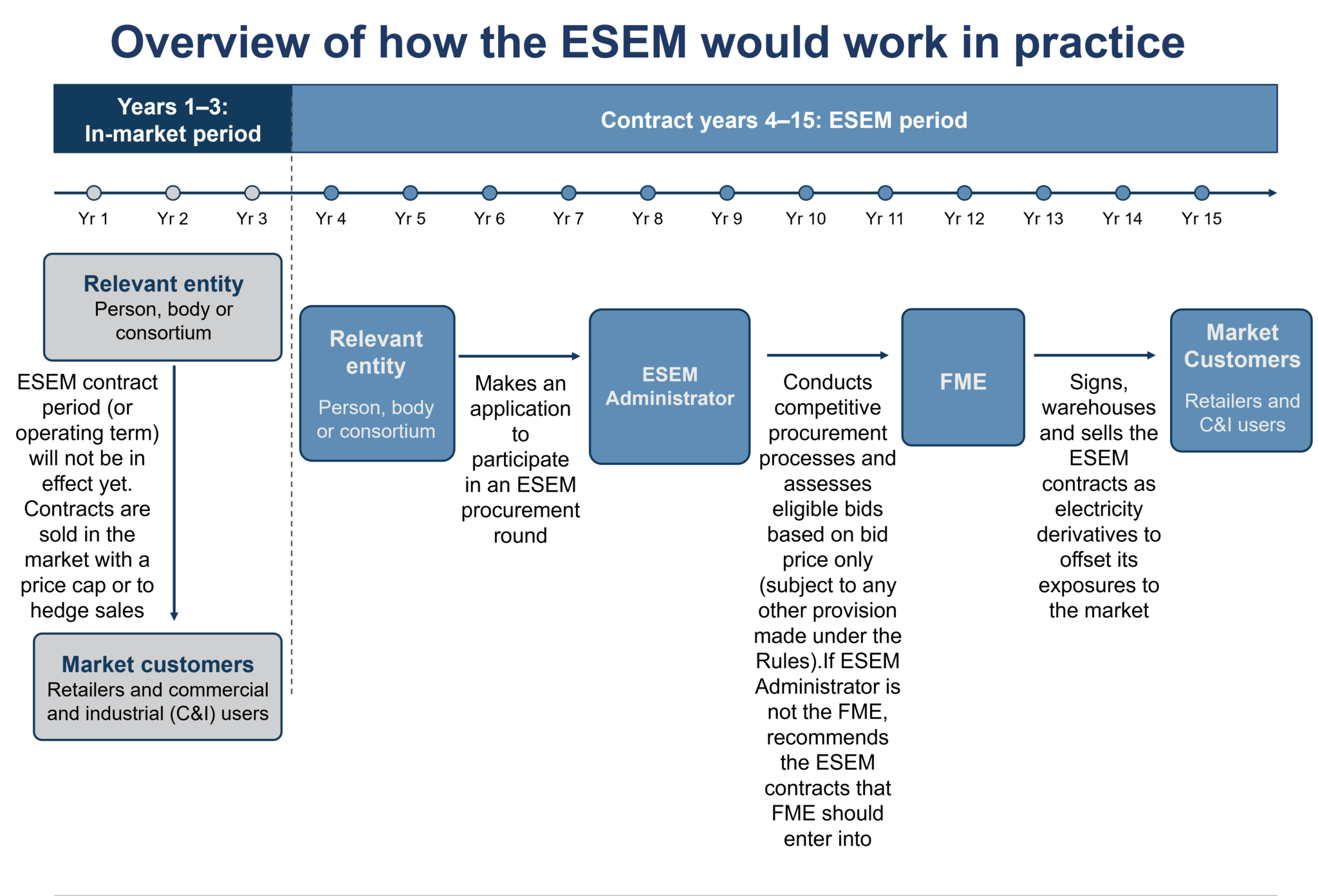
As currently proposed, the ESEM would be run by two entities. An ESEM Administrator would manage the scheme (including managing the procurement rounds and awarding the contracts). The ESEM Administrator would procure standardised, long-dated contracts for services from projects through regular competitive auctions. A Financial Management Entity (FME) would act as the enduring legal counterparty to those contracts. The contracts would be 'warehoused’ and the FME would progressively sell the contracts back to the market, which would allow the bulk energy, shaping and firming services to remain available to the market. The FME would be structured so that any gains or losses from its trading activities ultimately flow through to customers.
Eligible projects
To participate in an ESEM procurement round, a project must comprise new capacity, an expansion of existing capacity (including investment to make existing capacity dispatchable), or an end-of-life refurbishment that extends the asset's life for at least the in-market period plus the ESEM contract period.
A project is excluded if, when the procurement round opens, it is listed as “committed”, “in commissioning” or “in service” in AEMO's generation information, unless it is an eligible expansion or refurbishment. It is also excluded if the same capacity already receives jurisdictional revenue underwriting support, has previously been awarded an ESEM contract (other than for a refurbishment), or is the subject of a cost relief application.
Once operational, the project must deliver one or more ESEM services and be visible to AEMO. It must also target commercial operation before the in-market period begins, and meet any minimum size and other requirements in the ESEM (General) Guidelines, which are yet to be published.
Successful proponents must also meet strict delivery commitments, which are discussed under ‘Bankability considerations’ below.
How will the ESEM work in practice?
New projects would be contracted in two stages:
In-market period (e.g. project years one to three): An ESEM may be entered into, however the ESEM contract period (or operating term) will not be in effect at this stage. Projects would need to contract directly with offtakers (or be exposed to merchant revenues).
ESEM contracted period (e.g. project years four to 15): The period covered by the ESEM contract.
For an illustrative overview of how the ESEM is intended to work in practice, see Figure 1 below.
Proposed contract structures
The industry-led Electricity Contract Co-Design Working Group (the Working Group) has identified a preferred contract structure for each ESEM service, each taking the form of a standardised financial derivative. The Working Group tested these structures with the industry, with early feedback received from sellers, buyers, gentailers, consultants and industry bodies suggesting that the structures are broadly fit for purpose.
However, several issues remain unresolved, including the bankability of the contracts, technology neutrality, how the shaping product would operate in practice, and the benefits the products can offer buyers to manage financial risks.
Force majeure emerged as the most consistently raised issue across all three products. Most sellers accepted that asset-specific force majeure rights cannot sit within fungible contracts, however a separate, durable support framework would be required to support project-financed assets and to manage any force majeure risks. On the other hand, gentailers and buyers viewed force majeure as an ordinary commercial risk for sellers to manage.
Each structure, and the key themes raised in consultation, is outlined below.
Bulk energy services
The Working Group’s preferred product is a regional reference PPA, under which the contracted volume in each trading interval tracks the output of a reference fleet i.e., all operational projects of the same technology rather than the seller's own output. The buyer therefore bears regional volume and shape risk. The seller benefits if its project outperforms the regional reference fleet, and bears the risk if its project underperforms the fleet.
Stakeholders broadly welcomed the model, although questions remained about index design and whether the product can accommodate hybrid projects and offshore wind. There was universal support for a negative pricing regime, but there were split views on the mechanism: sellers favoured a $0/MWh price floor, while the buyers preferred a volume knock-out. Similarly, sellers backed the proposed $600/MWh price cap, whereas buyers resisted it due to concerns that it shifts high-price risk onto them and may require them to procure additional firming.
Firming services
The Working Group’s preferred product is a cap contract with a $600/MWh strike price, under which the buyer pays the seller a fixed premium and the seller pays the buyer the amount by which the spot price exceeds $600/MWh for the contracted volume. The Working Group favoured this over the conventional $300/MWh strike because it aligns with the current Administrative Pricing Cap (APC) and allows sellers to retain more merchant revenue below the cap, which should in turn lower the premium paid by buyers.
Although the cap structure itself was well received, the choice of strike price exposed a clear buyer-seller divide, with buyers sceptical of a $600/MWh cap that would leave them unprotected in the $300-$600/MWh range already hedged by today's widely traded $300/MWh caps.
In contrast, sellers preferred the higher level as it mirrors the APC and accounts for escalating running costs that may make a $300/MWh strike uneconomic for long-term contracts. Sellers further suggested that a $600/MWh cap could fail to reflect the value of long duration assets that can sustain output for more than eight hours.
Shaping services
The Working Group’s preferred product is a daily swap on the price spread between the charge and discharge periods. Those periods are set the day before using AEMO's day-ahead forecasts of residual demand, with up to two charge and two discharge blocks each day. The actual spread between the periods is settled against a fixed spread agreed in the contract. As a financial product, the seller is not required to charge or discharge in those periods, but a battery seeking to optimise returns may do so and will bear any difference between its own spread and the contracted spread.
While the spread-swap structure was broadly endorsed, this product attracted the most concern based on bankability, forecast accuracy, asset degradation and settlement options. In particular, stakeholders held differing views on the methodology for dynamic block setting. Energy users and retailers also queried the product’s value as a hedge where blocks are known only a day in advance, and whether residual demand forecasts is a reliable source.
With each structure still under development, the Working Group is now exploring protection for key themes across network outages, change in law and liquidity, and will use consultation feedback to settle its final positions. Its final report and recommended term sheets are due in November 2026, with long-form drafting to follow in 2027.
Bankability considerations
The draft package sets out the foundation for the ESEM, but it leaves several untested areas that sponsors and lenders will need to resolve before the ESEM can support project finance, including:
The creditworthiness of the ESEM counterparty. The FME would be a new statutory body, backed by a cost-recovery mechanism rather than an explicit government guarantee. The FME will be exposed to the gap between what it pays projects and what it receives when it resells contracts. Until it reaches critical mass and has an established trading record, the nature and extent of this risk is unclear.
The consultation paper states the FME’s statutory right to recover costs from Market Customers is intended to support it in achieving an investment-grade credit rating. Cost recovery will run through the weekly NEM settlement cycle, with AEMO passing ESEM costs through to the FME even where a Market Customer is suspended and any shortfall recovered in the following year.
These features are positive but unproven: an intended rating is not an assigned rating, the recovery mechanism results in a timing (liquidity) gap, and ESEM costs are quarantined by jurisdiction, so the depth of the cost-recovery base will vary by region.
Outage and FM risk – magnified for multiple services. Asset-specific force majeure relief would not be consistent with the desire for ESEMs to be standardised and fungible instruments, so a project that suffers an outage may remain liable to settle its contracted positions while earning no spot revenue. This exposure may be compounded where a project provides multiple ESEM services, particularly if the award for one service is contingent on an award for another (for example, a solar and battery hybrid offering bulk energy and shaping services).
Lenders will need to run downside cases on a combined outage across all contracted services, consider whether a default under one ESEM contract could trigger termination of the others, and assess what (if any) separate support framework is ultimately adopted for project-financed assets. This may also have implications for sizing of business interruption insurance and liquidity reserves.
The ESEM does not support the early years. The ESEM only contracts the later years of a project's lifecycle as an ESEM in-market period applies before the commencement of the relevant ESEM contract period (being a flexible period not shorter than 3 years to be set by the ESEM Administrator). However, loan repayments typically start when the project begins operating.
The project must contract in the market or bear the risk of those early years itself. Lenders may be asked to size debt against a contracted later period and a fully or partially uncontracted early period. Sponsors may push towards shorter-dated offtake contracts to bridge the early years, combined with sculpted or back-ended amortisation, cash sweeps and reserve accounts during the in-market period.
The proposed cost relief mechanism may assist here by encouraging offtakers to sign PPAs with new projects, although the cost relief drafting is less developed than other parts of the package and the value of credits will depend on the yet-to-be-settled ESEM cost structure.
Notice to Proceed (NTP) commitments. A successful proponent must commit to start construction by a NTP date that falls no later than one year after the FME accepts the award. The contract terminates automatically if there is a substantial delay, and the date can be extended only in limited circumstances such as force majeure.
A project would not ordinarily issue a NTP until approvals, grid connection, construction contracts and debt and equity funding are in place. Proponents will therefore need to be well advanced before they bid, and to align their construction and connection contracts with the ESEM timetable.Sponsors will also need to fund or procure bank guarantees for a bond covering the period from award until unconditional NTP, callable if NTP is not issued within one year. The proposed limitations on renegotiation after award also mean that financing conditions cannot readily be accommodated by amending the ESEM contract post-award.
Contract terms not settled. The pro-forma ESEM contracts, the ESEM contract period and the ESEM (General) Guidelines are yet to be published, so there is remaining uncertainty around the bankability of the approach to be taken to key terms such as settlement arrangements, termination rights, change in law risk allocation and credit support requirements. Much of the operative detail, including lead times, in-market and contract periods, delivery milestones and damages for non or late delivery, will sit in guidelines the ESEM Administrator may update to reflect lessons learned or changing market conditions. Lenders will want comfort that guideline changes cannot affect contracts already awarded.
Market making obligation (MMO). The Rule introduces a MMO that sits alongside the ESEM. Where the AER finds that trading in a service in a region is insufficiently liquid, the AER may require “Obligated Market Makers” (OMM) (being a person who provides firming, bulk energy or shaping services) to post simultaneous bids and offers for designated contracts, within set spreads and minimum volumes, for certain periods.
Lenders may have concerns about the impact these requirements will have on the financial performance of the ESEM Proponent. The MMO is intended to apply to suppliers above a specified threshold, and key parameters such as minimum volumes and bid-offer spreads will be set in AER guidelines that can be adjusted in response to market conditions.
Lenders will therefore want to confirm whether the project (or its sponsor group) is likely to be captured, how any trading costs and collateral requirements would be borne, and whether compliance with MMO notices is consistent with hedging and permitted trading covenants in the finance documents.- Security and step-in. Lenders will require the ability to take security over the ESEM contract and related contracts and to step in or novate them on enforcement. The draft package does not yet address assignment, direct agreements with the FME or lender cure rights.
The opportunities behind the ESEM’s warehouse model
Because ESEM contracts are firm, fungible and not linked to any particular asset, they suit the ESEM's warehouse model in which contracts are held and later recycled into the market. This flexibility creates three opportunities for Australia's future energy market, namely:
- Familiar contract forms. The ESEM would not introduce a new contracting framework. It would use the same forward contracts that market participants already use to manage spot market risk. Because these products are standardised, a recycled ESEM contract should look like any other hedge to a buyer, whichever project stands behind it. Buyers can manage risk within a framework they already know, which should encourage wider participation in the market.
- Transparent pricing and better value for consumers. Standardised contracts are priced through a structured centralised and market-recycling mechanism instead of negotiated on a case-by-case basis. This provides buyers pricing transparency as they can benchmark the price against the price offered for ESEM contracts.
- A more even playing field for smaller retailers: Recycled contracts would create a new source of wholesale hedging products for retailers, generators and traders. This could help smaller retailers and new entrants compete with large, vertically integrated energy companies, increasing both competition and liquidity in the market.
What is the status of ESEM?
The ESEM has not yet moved beyond draft form. The Department of Climate Change, Energy, the Environment and Water published the Bill and Rule for public consultation on 14 September 2026, which closed on 13 October 2026 at 11:59 pm (AEDT).
The intention is to seek unanimous Ministerial agreement in December 2026, with legislation expected to proceed through the South Australian Parliament in Q1 of 2027. In parallel and as explained above, the Working Group’s final recommendations on the standardised contracts are due by the end of 2026, with detailed design and long-form drafting expected to follow in 2027 ahead of the first ESEM auctions being held at the end of 2027/early 2028. The implementation taskforce has indicated that the reform remains on track.
Authors
Partner
Head of Banking and Finance
Partner
Partner
Partner
Special Counsel
Senior Associate
Tags
This publication is introductory in nature. Its content is current at the date of publication. It does not constitute legal advice and should not be relied upon as such. You should always obtain legal advice based on your specific circumstances before taking any action relating to matters covered by this publication. Some information may have been obtained from external sources, and we cannot guarantee the accuracy or currency of any such information.
Key Contacts


Other Contacts